Showing posts with label research. Show all posts

Tuesday, January 20, 2015

Skirting the Issue

Hortus Deliciarum
I have been living my life for the last few months surrounded by creative process and research. Spinning yarn, dying, embroidery, crocheting, sewing, writing papers, and teaching classes have all been occupying my time and life.  A large portion dedicated to researching and planning projects at various stages.  Which is okay.  I do love research and I enjoy sharing what I discover and sometimes it helps to form my opinions and a fresh perspective never hurts.

More recently I was working on a bliaut class.  Presenting general information and ideas to further define the concept of what it was.  A class that will find it's way here soon.  As I was delving into skirts, arguing against front gores, and expanding the view to include the bliaut gironĂ©, I began to more stiffly consider those side gores.  Traditionally I, along with many other seamstress, would cut our triangles, attach them to body panels, zip up the sides and call it fin.  While examining the flat panel fronts, I began to wonder about the rather full sides.  They seemed to me that in some works of art they were bearing a lot more fabric that simple gore would usually add.  Perhaps the gores had been pleated to add a fullness to the skirts.  I began to investigate these skirts further.

Well, upon digging around, I found the topic had already been researched a bit by one of my friends and I took a look at the different images of research that were offered up that were different than my own.  I began to feel two different ways about:

1. Upset.  I was hoping to offer up a new perspective on something that I was feeling really excited about.  When you have many people investigating something, someone else is more than likely going to notice it before you, but you try anyway.  The thrill of the new is an enticing thing and it is always a cold moment when someone else beats you to it.

2.  Proud.  I noticed something that my friend, a 12th century maven might I add, noticed and did not have to tell me about it.  I discovered it all on my own.  I didn't have to ride on anyone's back and point in the general direction while shouting "Take me there!"  It is rather nice to have my research skills confirmed.


"Foolish Virgins"
So, on to the bulk of the discovery.  It was the above image that made me think, originally brought up in a group regarding the gentleman's dags.  I found myself looking at the skirt, the relatively smooth front and the multitude of pleats of the side.  Very exciting to me.  I began to work through the small collection of images I had on Pinterest, cell phone, and laptop. 

The next one quite simply is the most popular image of the Foolish Virgins, Italian.  Looking off our whimsical lady's hip, the tiny lines of folds appear quite a bit, indicating more pleating on the side in the gore area.

Next illustration is from the Carmina Burana.  The long graceful lines of pleating can be seen running from waist to hem in the green dress.

Finding illustrations from various areas was good, but when I began to look around at the various groups I belonged to, two images I found delighted me.  A relief sculpture and an extant garment.  Both items only sealed this notion I had regarding the gore treatment in these skirts.  The best is the 12th century alb shown below.  The stitches used to make the smocking have quite the decorative effect.

I still have no idea why I was completely oblivious to these pleated gores up until now, but as I plan my bliaut, I am certain this effect will be quite stunning.  I hope to begin it sometime this spring as we approach event season.  A little something to wow to boys and girls.


Relief from a cathedral in Modena

Monday, September 1, 2014

I Hate Gold Thread

Fecamp Palster
I know it's an odd title for a post "I hate gold thread," however working on this new project and what it commands has really just confirmed how much I hate working with gold thread.  It unravels, frays, knots, breaks, strips off the core, and is a general pain in the butt.  I force myself to work with lengths between eight to ten inches to minimize issues, but with such short lengths it only ever feels like I am constantly cutting more to work with than I am actually working with.  I honestly can't stand the stuff.

But why is this important to my research?

It's not.  I just needed to share my irritation.

So what am I working on here?

Funny you should ask!  Let me tell you after spending much time researching the volume sleeve from my last post, I really found myself 
You remember this one, right?
drawn to Philosophia's dress. I began to check out other similar style sheath dresses.  Which is rather daring when you aren't a size 10 or even a size 16.  Mundane sheath dresses and myself get along about as well as me and gold thread.  But I really like the dress and so, I am taking a plunge here.


I floated through some images and noticed that sheath dresses were usually a patterned fabric, presumably silk, with large sleeves. Sometimes those sleeves were a trumpet or pendant style.  While long, by modern sense, the dress only comes down to about a little lower to mid shin on average with the under dress pooling at the feet.  Of course, I am not going to stop there, I also wanted to look at the available fabrics.  While checking on the brocade patterns found in extant examples, all woven examples were of silk. Other examples of finds made of linen were block printed.  I considered the
print theory, knowing that either one would be acceptable, but in thinking how noble and honored these ideals and ladies were, linen wouldn't be enough.  They would have to be rich and nearly decedent.  Decedent like silk.

By the way, I am of the school there is no such thing as too many pearls.  And the only natural pairing for silk is pearls.  God, I love the 12th century.


German painted linen
Now, let me say this clearly, I love playing in the SCA and I love the freedom it grants me to try out ideas and attempt to create something unique and at the same time historically based.  Because of this I do not admonish those whom like their creations to exactly emulate illuminations, statues, or extant finds.  I rather admire their attention to detail.  However, I am going for the reaction of "That looks like it belongs."  So, when I piece it together, you will see my personal artistic expression in a historically drenched goodie.
Spanish silk brocade

If you don't like it... well, you wouldn't still be reading would you?

You can see much more substance in the brocade than the linen.  Painted linen is awesome, but in the images considered, the silk is more likely for the depth of the aesthetic qualities that the artists seem to be rendering in the palsters and illuminations.

Now, not too stray too far from the given designs, in Philosophia's dress, the trim around the hem is going to be the inspiration for the strip of silk that will be running down the front.  I have yet to decide on pendant or trumpet sleeves.  That has yet to be decided and I have plenty of time for that.

Now, if you'll excuse me, I have more gold thread to go and hate.

Wednesday, July 16, 2014

Query of the Sleeve

Stuttgart WLB, cod. fol. library. 56, <
origin: Abbey of Zwiefalten, 1125-1130
It is fair to say that I love my academic pursuits.  I love working on papers like when I was in college.  A current project of mine is a full paper on the bliaut, including underpinnings and accessories.  While investigating for the paper, I cruised through a French site of a 12th century reenactor and an idea she proposed for an under dress caught my eye.  Though I didn't entirely agree with the execution, the idea was enough to propel me into doing my own research.

Originally when I was viewing these and similar images, I wasn't really paying a whole lot of attention to the under dresses.  I was looking at the construction and embellishment of the over dresses and the adornments.  But now that the images have caught my eye, looking carefully it would seem that sleeve of the under dresses are tight up around the wrist and the billow out and follow the curve of the overlaying pendant sleeves.  They are rather full and often ripple around the edges of the over dress.  Occasionally they appear to be open, with the bell laying flush against the over dress sleeve pendant and other times they appear to be closed with one long front center seam.  The cuffs often have the trapunto look I adore.


12th Century German palster of Philosphia
Not all full sleeves that ripple over the outer dress appear to be this billow type of under dress and could very well be just a full lining.  However, there is one image that I do find interesting and does depict that billow under sleeve rather sharply.  I did try to chase down the original source having found it in groups, Pintrest, blogs, and even a Spanish language site devoted to 12th century philosophy and it's effect on the Christian church, but I didn't find a whole lot.  I am sure some day I will learn more on it.  However, the sleeve is the thing.  You can see it flows from the wrist on down showing that it is not a sleeve lining, but a part of the underdress itself.  Even the skirt flowing out from under the much more narrow over dress contains more volume and fabric, indicating something rather luxurious lays beneath.

It is worth researching further to determine if it was something done.  While most examples seem to be German, I don't recall seeing any immediately French examples.  But then again, this is a notion I only began to play with this morning and so I have only begun to scratch at it, though the same images keep on popping up again and again on my internet searches as I try to make it past the groups and sites where my curiosity begins. 

More digging is needed!!


Tuesday, January 21, 2014

Trapunto, Take Two

Gospel of Henry the Lion
It's been a rough kind of work day.  The kind of day where once I am home, I need to forget about the real world and indulge my habits of sewing, research, and helping others along that path.
 
Yes. I intend to add more educational things and not just show off what I have been working on.  I still intend to do that too.  After several years of researching and watching what others were doing I feel more confident now sharing what I do.  We all get there in our own time.
 
Alors, onto the project of the week, or rather a few weeks ago.

If you remember this project, I have a variation of the kind.  This is a linen under dress with a trapunto neck and embroidered cuffs.  The sleeves were made extra long to give them a gathered effect at the wrists.  Historically the under dress, or shifts, or chemise was linen and white color.  We know from various bits of illuminations, such as above, and references in literature.  Marie de France is one example of a 12th century author whose vivid descriptions of linen depicted it as "snowy" or "white as a meadow flower."  I am going the color route, just to keep things interesting for me.

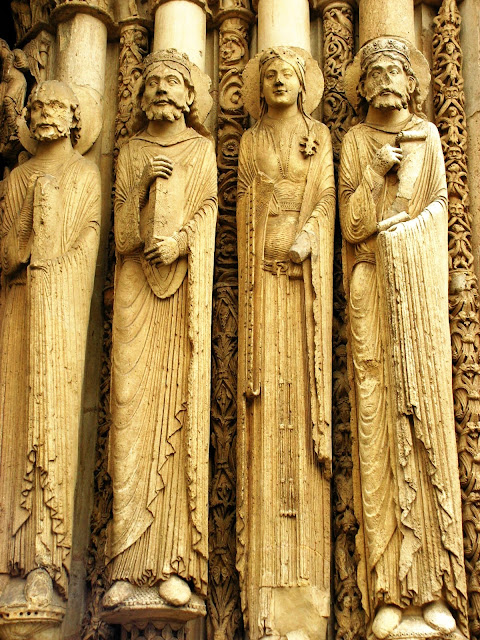
I based the whole of the dress on a piece of statuary from the Chartes.  You can see the curve of the neck, a single button at the top,
 and then the structure of the cuff, more of a decorated band.


Friday, June 28, 2013

A Happy Find

I wasn't planning on posting my bliaut work tonight. I really wasn't planning on posting anything.

Here's what went down:

I am planning a few more garments for the husband and myself. On Facebook Bella has this group where she shares her own ideas based on observations. One of the ideas that had me intrigued was the skirt being cut separately, pleated, and attached by a decorative band. I began my own research and found it referred to as a bliaut gironé, a style confirmed by Scandinavian archeologists. See: Medieval Clothing and Textiles 8 byRobin Netherton, Gale R. Owen-Crocker. A book I plan on trying to procure and not just stuck with limited access to for Web previews.

Alors!  Information sleuthing is my strong point.

Well, I thought I would see about finding some images when I found one I hadn't seen before. I got down right giddy. I found an image of an extant garment. The tunic of Don Garcia from the 11th century, from a site in Spain, made of silk. I could see how high the lacing went up, where the gores were, and how exact the keyhole neck was. Though it is earlier than what I am doing, it is still significant for the purpose of construction. It looks so much like the illuminations and stone carvings I almost became down right enthusiastic.

I don't recall ever seeing it before. And I was very glad to have found it. I am sure others have. But for the moment, the find was mine.

 tunic of Don Garcia

Wednesday, June 26, 2013

Tramping About with Trapunto

The Tristan Quilt on display at
the Victoria & Albert Museum
Recently I had an interesting concept introduced to me by a friend. The technique of trapunto being used to create a decorative relief in the collar and cuffs of under tunics in both men and women's garments. While there are no physical garments to confirm this, there is plenty of art to compound the possibility.
 
Trapunto was used primary in bed linens and armor, layering and stuffing channels for gambisons. The first three images are just of that, Italian.
 
Look at cuffs and necklines of the Chartes cathedrial figures presented.
Now, if a seamstress were willing to apply the craft to armor, bedding, and accessories, then why not to the clothing as well?  Sculptors and illustrators seemed to think it a good idea, and not just in one region.  Though, the bulk of them seemed to be in France. 
 
Looking at the cuffs, I began to doubt that they were gathered as they all have the effect only on one side. 
There was another image of a man in bed and he had a similar effect, but also with buttons.


I was able to find a bag that was done using the technique. A rather elaborate piece.